Are Workplace Security Cameras Legal?
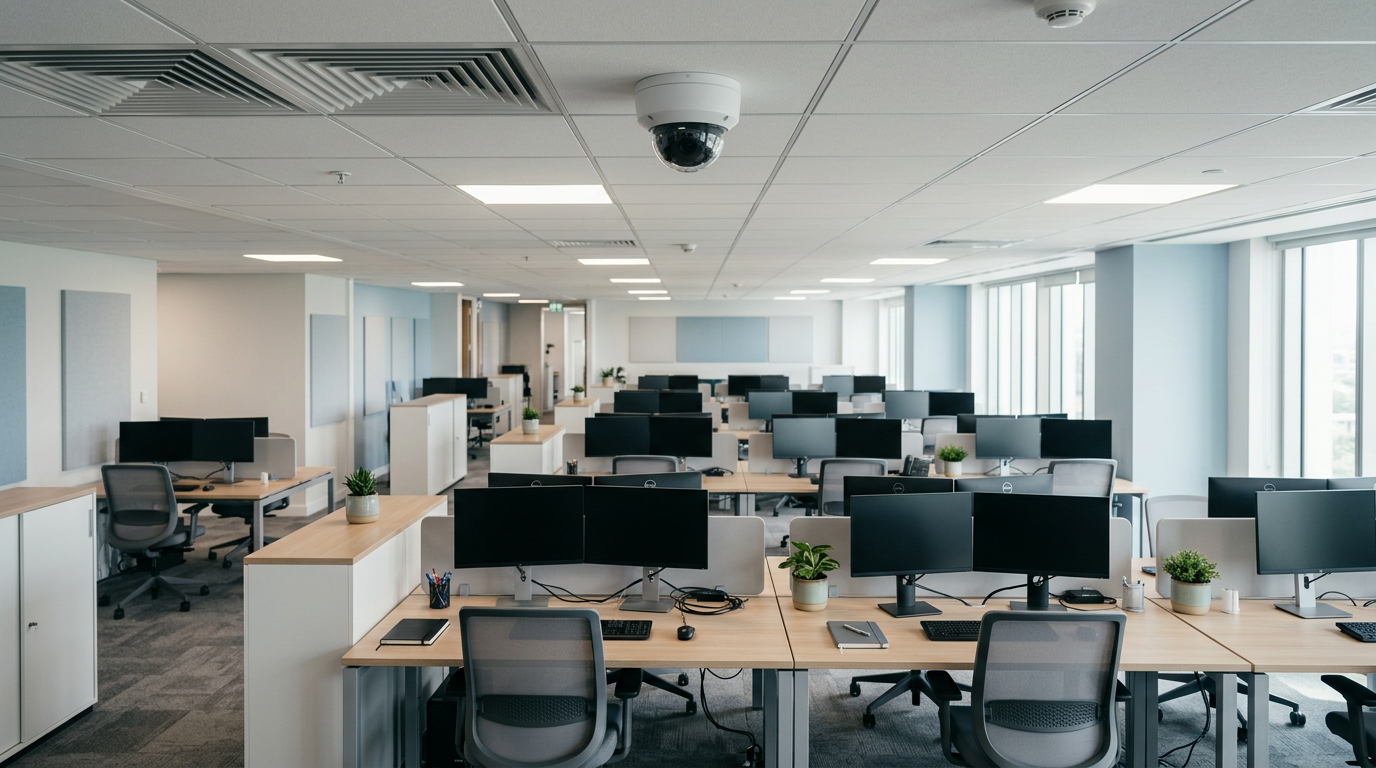
Workplace security cameras are increasingly common. Employers install them to prevent theft, ensure safety, and monitor productivity. But the legality of workplace surveillance varies significantly depending on where you are and how the cameras are used.
This guide covers the key legal frameworks governing workplace security cameras in the United States, the United Kingdom, the European Union, and other major jurisdictions.
United States
In the U.S., there is no single federal law that comprehensively addresses workplace video surveillance. Instead, the legality is determined by a combination of federal and state laws.
Federal Law
The Fourth Amendment protects against unreasonable searches by the government, but it does not directly apply to private employers. The primary federal statute relevant to workplace monitoring is the Electronic Communications Privacy Act (ECPA) of 1986, which primarily addresses interception of electronic communications rather than video surveillance.
However, the ECPA does restrict audio recording — recording workplace conversations without consent can violate federal wiretapping laws under Title I of the ECPA (18 U.S.C. § 2511).
General Principles
- Video-only surveillance is generally legal in common areas such as lobbies, hallways, warehouses, and retail floors.
- Audio recording is subject to stricter rules. Federal law requires at least one-party consent, but many states require all-party consent.
- Areas with a reasonable expectation of privacy — restrooms, locker rooms, changing areas, and break rooms — are off-limits for cameras in virtually all jurisdictions.
- Notice — while not always legally required, informing employees about surveillance is strongly recommended and required in some states.
State Variations
State laws vary widely:
- Connecticut (Conn. Gen. Stat. § 31-48d) requires employers to provide written notice before engaging in electronic monitoring, including video surveillance.
- California has strong privacy protections under the California Constitution (Article I, Section 1) and the California Invasion of Privacy Act (Cal. Penal Code § 630-638), which require all-party consent for audio recording.
- New York (N.Y. Lab. Law § 203-c) prohibits video surveillance in restrooms, locker rooms, and rooms designated for changing clothes.
- Delaware (Del. Code tit. 19, § 705) requires employers to give notice of electronic monitoring to employees.
- Texas has relatively permissive surveillance laws but prohibits cameras in areas where employees have a reasonable expectation of privacy.
Union Workplaces
Under the National Labor Relations Act (NLRA), employers in unionized workplaces may be required to bargain with the union before installing surveillance cameras, as this constitutes a change in working conditions.
United Kingdom
The UK has a well-developed legal framework for workplace surveillance.
Data Protection Act 2018 & UK GDPR
Workplace camera footage is classified as personal data under the Data Protection Act 2018 and the UK General Data Protection Regulation (UK GDPR). Employers who operate CCTV systems are considered data controllers and must comply with data protection principles:
- There must be a lawful basis for processing (typically "legitimate interests" under Article 6(1)(f) of UK GDPR).
- Surveillance must be proportionate — employers must demonstrate that less intrusive means would not achieve the same purpose.
- Employees must be informed about the surveillance, its purpose, and how the footage will be used.
- Footage must be stored securely and retained only as long as necessary.
The Employment Practices Code
The Information Commissioner's Office (ICO) has published guidance on monitoring at work. Key recommendations include:
- Conducting an impact assessment before deploying cameras.
- Being transparent with employees about monitoring.
- Not using covert surveillance unless there are grounds for suspecting criminal activity or equivalent malpractice, and only after authorization by senior management.
- Ensuring cameras are not placed in private areas such as toilets or changing rooms.
Human Rights Act 1998
Article 8 of the European Convention on Human Rights (ECHR), incorporated into UK law through the Human Rights Act 1998, protects the right to respect for private and family life. Workplace surveillance that is disproportionate or lacks proper justification could be challenged under this provision.
European Union
General Data Protection Regulation (GDPR)
The GDPR applies to all EU member states and imposes strict requirements on the use of workplace surveillance cameras:
- Employers must have a legitimate interest that is not overridden by the employees' fundamental rights (Article 6(1)(f)).
- A Data Protection Impact Assessment (DPIA) is required when surveillance is likely to result in a high risk to employees' rights (Article 35).
- Employees must receive clear and accessible information about the surveillance (Articles 13-14).
- Covert surveillance is only permitted in exceptional circumstances and is subject to strict conditions.
Country-Specific Variations Within the EU
- Germany — the Federal Data Protection Act (BDSG) § 26 provides specific rules for employee data processing. The Federal Labor Court has set strict precedents on proportionality of workplace surveillance.
- France — the CNIL (Commission Nationale de l'Informatique et des Libertés) requires that workplace cameras not continuously monitor employees at their workstations. Employees and works councils must be informed before installation.
- Spain — the Constitutional Court has ruled that covert cameras may be used only when there is reasonable suspicion of misconduct and no less invasive means are available (STC 39/2016).
- Italy — the Workers' Statute (Article 4) requires agreement with trade unions or authorization from the labor inspectorate before installing surveillance systems that could monitor employee activity.
Canada
Federal Level
The Personal Information Protection and Electronic Documents Act (PIPEDA) governs workplace surveillance in federally regulated industries. Employers must demonstrate that surveillance is reasonable and necessary for a legitimate purpose.
Provincial Level
- Alberta and British Columbia have their own privacy legislation (PIPA) that applies to private-sector employers.
- Ontario does not have comprehensive private-sector privacy legislation, but the Workplace Surveillance Act, 2024 introduced requirements for electronic monitoring policies.
In all Canadian jurisdictions, the principle of proportionality is central — surveillance must be the least intrusive means of achieving a legitimate business objective.
Australia
Under the Workplace Surveillance Act 2005 (NSW), employers must provide at least 14 days' written notice before commencing camera surveillance. Covert surveillance requires authorization from a magistrate and is only permitted when there are reasonable grounds to suspect unlawful activity.
Other states and territories have their own legislation, but notice requirements and restrictions on surveilling private areas are consistent themes.
Key Takeaways for Employers
Regardless of jurisdiction, employers considering workplace security cameras should follow these principles:
- Conduct a risk assessment — determine whether cameras are truly necessary and proportionate.
- Provide clear notice — inform employees about the location and purpose of cameras through a written policy.
- Avoid private areas — never place cameras in restrooms, changing rooms, or similar spaces.
- Limit audio recording — understand that audio surveillance is subject to stricter legal requirements than video in most jurisdictions.
- Secure the footage — protect recorded data and retain it only for as long as necessary.
- Review regularly — periodically assess whether the surveillance remains justified and proportionate.
Key Takeaways for Employees
If you believe workplace surveillance may be unlawful:
- Check your employment contract and company policies — look for clauses on monitoring and surveillance.
- Know your local laws — rights vary significantly by jurisdiction.
- Document your concerns — note camera locations, especially in private areas.
- Raise the issue internally — speak with HR or your union representative.
- Contact the relevant authority — in the UK, the ICO; in the EU, your national data protection authority; in the US, your state labor board or an employment attorney.
Conclusion
Workplace security cameras are legal in most jurisdictions, but their use is subject to important restrictions. The common thread across all legal frameworks is the balance between an employer's legitimate security interests and employees' right to privacy. Employers who install cameras without proper notice, in private areas, or with audio recording capabilities risk legal liability. Employees, in turn, have rights and avenues for recourse when surveillance crosses legal boundaries.