The Year Everything Went Wireless
If you had to pick one year when the wireless future truly started taking shape, 2006 would be a strong contender. That December, British Sky Broadcasting and Google announced a landmark broadband alliance — one of the first major partnerships between a traditional broadcaster and a tech giant. The deal bundled Gmail, video sharing, and search into Sky's broadband offering, signaling that the boundaries between TV, internet, and mobile were dissolving fast.
But while Sky and Google were connecting living rooms to the cloud, another wireless revolution was quietly unfolding in people's pockets and on their ears.
Bluetooth 2.0+EDR: The Standard That Changed Everything
By 2006, Bluetooth 2.0 with Enhanced Data Rate (EDR) had become the dominant standard in mobile phones. The upgrade was significant:
- Data speeds up to 3 Mbps — three times faster than Bluetooth 1.2
- Lower power consumption — longer battery life for both phones and accessories
- Improved connection stability — fewer dropped calls and audio glitches
This wasn't just a spec sheet improvement. It was the tipping point that made Bluetooth accessories genuinely useful for everyday people.
The Golden Age of the Bluetooth Headset
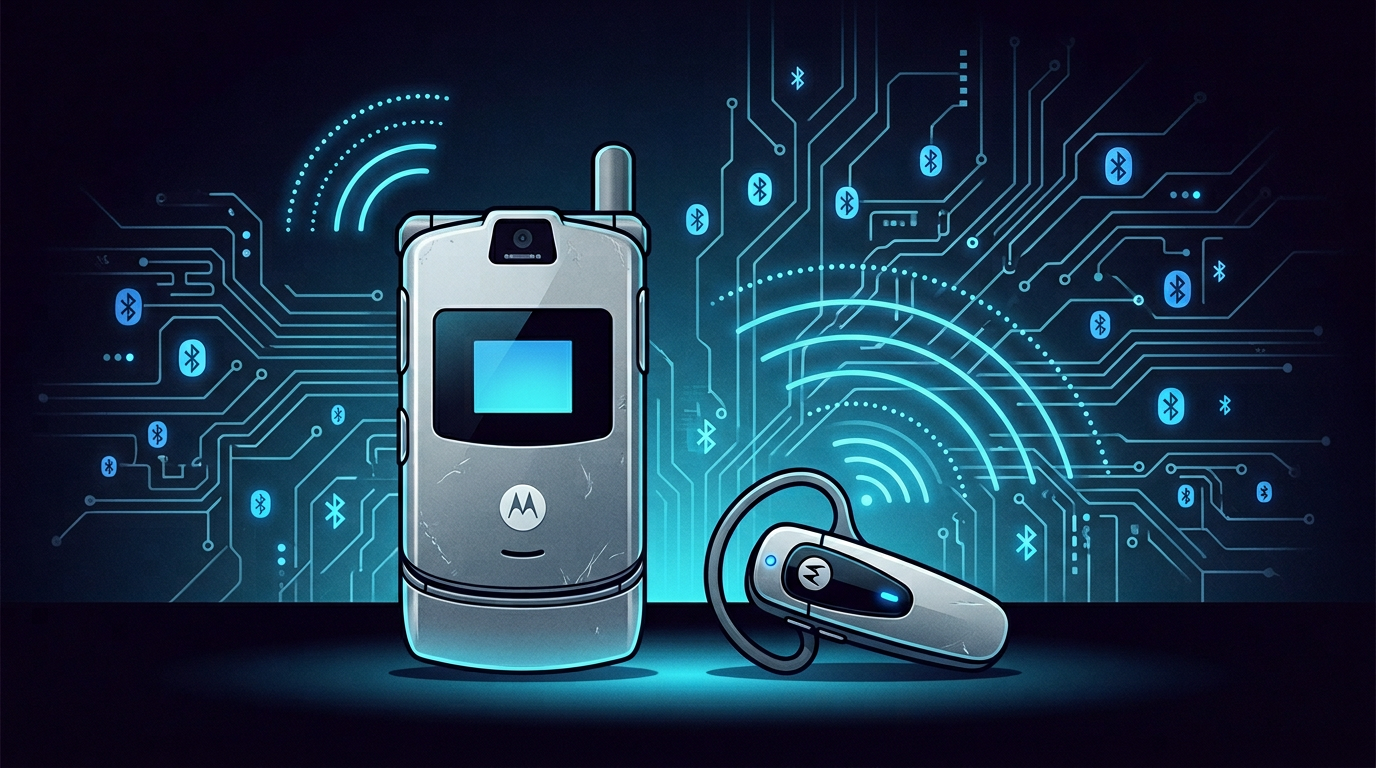
2006 was peak Bluetooth headset culture. Walk into any airport, coffee shop, or office, and you'd see people with blinking blue earpieces clipped to their ears. The Motorola H700, Jawbone, and Plantronics Voyager became status symbols for busy professionals.
Why Headsets Exploded in 2006
- Hands-free driving laws — California and other states passed legislation requiring hands-free devices while driving, taking effect in 2008 but spurring early adoption
- Affordable prices — headsets dropped below $50 for decent models
- Universal compatibility — Bluetooth 2.0 worked across all major phone brands
- The RAZR effect — Motorola's wildly popular RAZR V3 shipped with Bluetooth, putting the technology in millions of pockets
A2DP: Music Goes Wireless
Perhaps the most forward-looking development of 2006 was the mainstream adoption of the Advanced Audio Distribution Profile (A2DP). For the first time, you could stream stereo music from your phone to wireless headphones.
The audio quality wasn't great by today's standards — early A2DP implementations suffered from latency and compression artifacts. But the concept was revolutionary. No more tangled cables. No more yanking earbuds out of your ears when you stood up.
A2DP in 2006 planted the seed that would eventually grow into the AirPods phenomenon a decade later.
The Sky-Google Deal: A Parallel Revolution
The Sky-Google broadband alliance was remarkable for what it revealed about the industry's direction:
- Video from mobile phones — Sky launched a portal for uploading and sharing video shot on mobile devices, anticipating the smartphone video revolution
- Email everywhere — Custom @sky.com Gmail addresses meant your communication followed you across devices
- Converged advertising — Google gained access to Sky's TV audience data, previewing the cross-platform ad targeting that defines digital marketing today
- VoIP exploration — The companies discussed internet telephony, foreshadowing FaceTime and WhatsApp calls
What tied it all together was the assumption that people would move seamlessly between screens and devices. Bluetooth was the invisible thread making that personal device ecosystem possible.
What Came Next
The groundwork laid in 2006 set the stage for everything that followed:
- 2007 — Apple launched the iPhone with Bluetooth 2.0+EDR, forever changing how we think about mobile connectivity
- 2009 — Bluetooth 3.0 arrived with high-speed data transfer
- 2010 — Bluetooth Low Energy (BLE) was introduced in the 4.0 spec, enabling fitness trackers, beacons, and eventually AirTags
- 2016 — Apple removed the headphone jack from the iPhone 7, making Bluetooth audio the default
- 2020 — True wireless earbuds became the fastest-growing consumer electronics category
The Legacy of 2006
Looking back, 2006 was the year when two parallel wireless revolutions — big (broadband, cloud services, content streaming) and small (Bluetooth, personal accessories, device-to-device communication) — began converging into the connected ecosystem we live in today.
The Sky-Google deal showed that the future of media was wireless and multi-device. Bluetooth 2.0 showed that the future of personal technology was wireless and hands-free. Together, they painted a picture of a world where every device talks to every other device — a world that has very much arrived.
Conclusion
The wireless world we take for granted today — streaming music to our AirPods, tracking our devices with Bluetooth, seamlessly switching between phone and laptop — has roots that trace back to developments like the 2006 Sky-Google alliance and the maturation of Bluetooth 2.0. Understanding this history helps us appreciate how far we've come and anticipate where wireless technology is headed next.